
Teaching of Reading
Reading at High Spen Primary School
Reading is such a vital life skill.
It brings us joy and fulfilment as well as access to a wide range of opportunities throughout life.
At High Spen, we prioritise reading so that all pupils learn to read easily, fluently and with good understanding. We foster positive reading habits so that children are not only able to read, but choose and want to read too.
We see our provision as consisting of four key building blocks to becoming a good reader. We would be delighted to talk through or explain any of the blocks below.
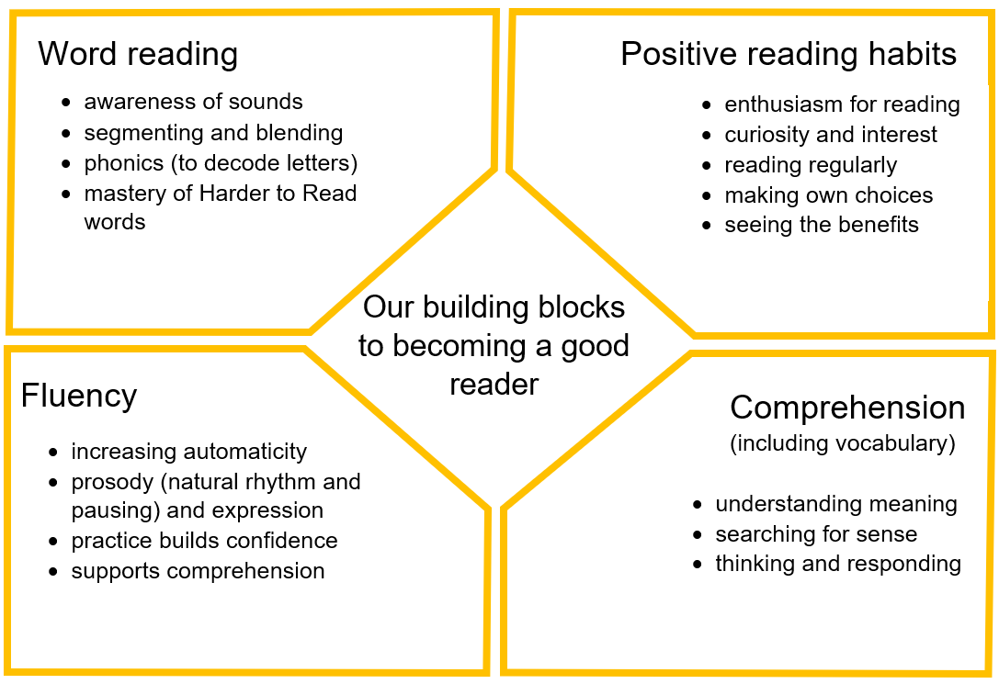
Word reading
Skilled word reading involves speedy decoding and automatic recognition of words.
It starts with foundational skills in Nursery focusing on listening, speaking and early sound awareness. This progresses to recognising and clearly producing letter sounds (phonemes) and to blending and segmenting these sounds orally.
It is at this point (usually at the start of Reception), that we begin to teach our full Phonics programme with daily sessions. Children learn to link the phonemes with their written forms (letters or graphemes). They first learn simpler 1:1 correspondences then learn that sometimes multiple letters can make one sound (for example sh, igh, eigh).
In order to read, children must know the letter sound code and be able to blend the sounds together into words. At the same time, children also learn common words, like ‘the’ and ‘I’, which do not follow the phonic code. We call these Harder to Read words.
At High Spen, we use the Essential Letters and Sounds (ELS) programme, including the ELS Foundation Stage programme to develop children’s word reading. We aim to complete the programme by the end of Year 1 although it can sometimes take longer.
Follow the link to find more information about the ELS programme, how we teach it and the order the sounds are taught in. There are also videos to show how you can support your child’s word reading at home, including clear and precise pronunciation of phonemes and ways to help with blending.
Fluency
Once children can decode, the next step is fluency.
Fluency develops in stages throughout the ELS programme - as children acquire more and more of the phonic code - and indeed beyond. The aim is to read accurately, quickly and with confidence. As their reading becomes more automatic, children can focus increasingly on meaning.
Young readers need time to continue building up their fluency even after they have completed the ELS programme as they encounter more challenging texts. Our colour book band system supports this; the challenge gradually increases as children move through the colour bands. In our library we use Starred Books to do a similar job. These books are marked with coloured stars according to their Lexile Level (a measure of a text’s vocabulary and sentence structure). Re-reading (reading a text several times) can really help with fluency too and is, in fact, an important strategy with young readers.
We also support fluency by teaching prosody. Teaching prosody involves children learning the natural rhythm and pausing in language – the opposite of the sometimes stilted, robotic reading you sometimes get in young readers. Prosody is also key to comprehension.
Comprehension (including vocabulary)
Ultimately, when we read a text, the aim is to understand it and understand it well.
From Nursery, we read together with our pupils to discover and make sense of the stories, ideas and information contained within words and texts. In Early Years and Key Stage 1, we have Baskets of Books (collections of quality and inspiring books) for this very purpose.
From Year 2 onwards, we teach regular Reading Workshop sessions to hone comprehension and vocabulary skills still further (usually in conjunction with fluency and prosody skills). We use a range of high-quality and engaging texts and focus on key comprehension skills such as retrieving, inferring, predicting and summarising. Talk and discussion are at the heart of our comprehension work.
Positive reading habits
We never want reading to be a chore for our pupils but something they want, and choose, to do.
To support this, we at High Spen aim to develop curiosity and interest through our Baskets of Books and through our Books to Treasure collections in every class. From Year 3 onwards, we share class novels and sample Featured Authors (twelve selected authors who we spotlight over the course of Key Stage 2) together.
Children throughout school have opportunities to make reading choices for themselves – not least through our regular class library sessions – and to share their preferences and recommendations with class mates. We talk with our pupils about the wider benefits of reading – for our minds, for our emotions and for our wellbeing – both on a personal level and collectively.
If you have any questions, or would like further information, about how we teach and develop reading at High Spen, please ask in school. We will be delighted to share more and support you at home in any way we can.