
Attendance and Absence
Parents and Carers are informed about their child’s attendance level through annual reports and where attendance is above 96%, celebration certificates. Should attendance fall short of expected levels – five weekly monitoring begins. Attendance below 90% will trigger Attendance Monitoring, with initial letters from myself, leading to the involvement of our Attendance Governor and ultimately the Education Welfare Service/Legal Intervention Team. BUT - our children LOVE coming to school - so let's focus on getting them in so they can learn, play and quite literally, set themselves up for life!
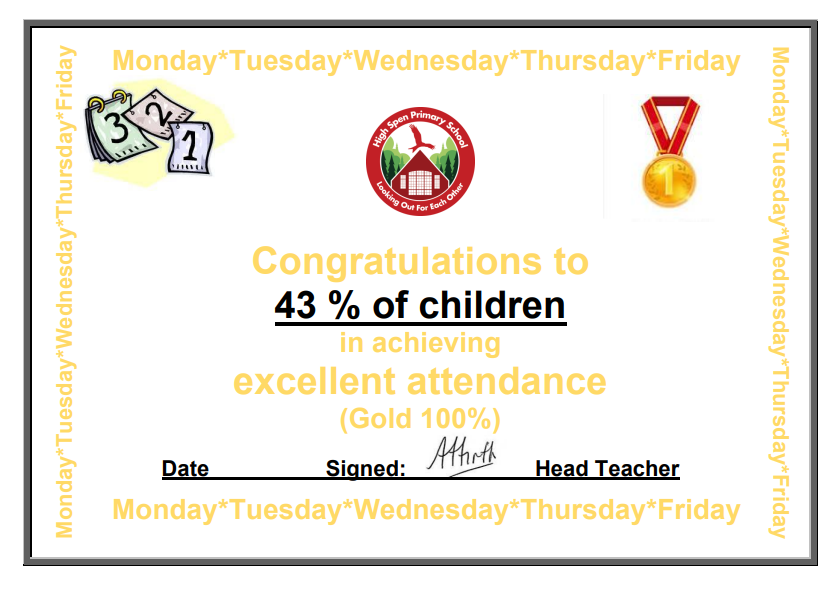 We understand that sometimes absence is simply unavoidable, for this reason our celebration certificates recognise attendance hitting 96% (Bronze), 98% (Silver) and 100% (Gold).
We reset the clock every ten weeks, meaning that if a child has been ill or taken on holiday (this is not the child's choice), their chance to achieve a celebration certificate reopens for the following ten week period. 72% of children achieved an Attendance Certificate in our last measuring window!
Why is it important for children to attend school regularly?
The vast, vast majority of parents and carers want their children to get on well in life. Nowadays, it is more important than ever to have a good education behind you if you want better opportunities in adult life. Children only get one chance at school and your child’s chances of a successful future are best served by attending school regularly.
It is not only the academic work; missing out on the social side of school life – especially at primary school – can affect children’s ability to make and keep friendships, a vital part of growing up personally and emotionally.
Setting good attendance patterns from an early age, from nursery classes through primary school will also help your child later on.
Employers want to recruit people who are reliable. So children who have a poor school attendance record and poor sense of routine, may have less chance of getting a good job.
Being on time is also vital. Arriving at school late can be very disruptive for your child, the teacher and the other children in the class. Our school bell goes at 8.55am, by getting them in on time means you get to wave them off as they walk in with a line of friends.
Research shows that children with poor attendance often fail to make expected progress in secondary school, achieving less well at GCSE level. It also shows that children who are not in school are most vulnerable and more easily drawn into crime at both primary and secondary levels. So let's get them in and give them the best possible start to life!
What does the law say?
By law, all children of school age must get a suitable full time education. As a parent/carer, you are responsible for making sure this happens by registering your child at a school and then making sure she or he attends regularly.
If your child fails to attend regularly, the Local Authority (Education Welfare Service) can take legal action against you. The Local Authority is responsible for making sure that parents fulfil their responsibilities in ensuring that their children attend school.
Planned absence in term time
Should you need to take your child out of school during term time, a Leave of Absence form will need to be completed. We understand that there can be exceptional circumstance in which you may need to do this – please ask the school office for a ‘Leave of Absence Form’.
If the Leave of Absence is for a term time holiday, the absence will not be granted (unless we feel there are exceptional circumstances), and where the threshold is met, fines will be generated.